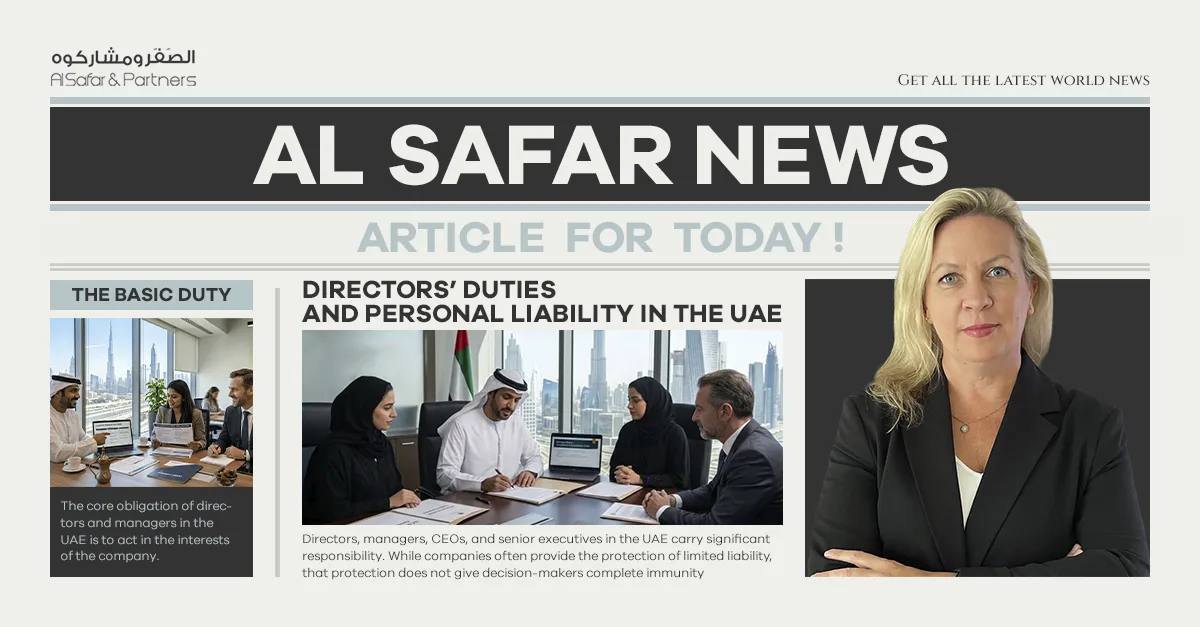
Directors, managers, CEOs, and senior executives in the UAE carry significant responsibility. While companies often provide the protection of limited liability, that protection does not give decision-makers complete immunity. Executives may still face personal liability if they act dishonestly, misuse their authority, breach the law, ignore conflicts of interest, or fail to respond properly when the company is in financial distress.
The UAE corporate framework is mainly governed by the UAE Commercial Companies Law, Federal Decree-Law No. 32 of 2021. However, the applicable rules may differ depending on whether the company is incorporated onshore, in a free zone, or in a financial free zone such as the DIFC or ADGM. For this reason, every executive should understand not only their title, but also the legal source of their authority and the jurisdiction in which the company operates.
1. The basic duty: act in the company’s best interests
The core obligation of directors and managers in the UAE is to act in the interests of the company. This includes exercising reasonable care, acting within the company’s objects and constitutional documents, protecting the company’s rights, and using management powers for proper purposes.
This duty is not limited to formal board members. It can also apply to general managers, CEOs, executive directors, authorised signatories, and others who exercise real management authority. In practice, liability can follow function, not just title. A senior executive who makes or controls important decisions may face scrutiny even if they are not formally described as a “director.”
Executives should also be cautious about relying too heavily on indemnities or protective clauses in corporate documents. UAE law generally does not allow a company’s memorandum or articles to exempt officers from liability for their own misconduct. Internal documents can define authority, but they cannot excuse unlawful or improper conduct.
2. When personal liability can arise
Personal liability may arise where a director or manager commits fraud, abuses their powers, violates the law, breaches the company’s memorandum or articles, acts outside their authority, or makes a gross management error.
For limited liability companies, managers may be liable to the company, partners, or third parties where their conduct causes harm. For joint stock companies, directors and executive management may also be liable for fraud, abuse of power, breaches of law, breaches of the company’s articles, or management errors.
Board procedure is especially important. If a board decision is taken unanimously, all participating directors may be exposed. If a decision is passed by majority, a dissenting director should make sure their objection is clearly recorded in the minutes. Simply being absent from a meeting may not be enough to avoid liability if the director later becomes aware of the decision and fails to object.
The practical lesson is clear: directors should not treat board minutes as a formality. Minutes should show what information was reviewed, what risks were considered, what questions were asked, and whether any director disagreed.
3. Conflicts of interest and related-party transactions
Conflicts of interest are one of the most common sources of personal liability. A conflict can arise where a director, manager, shareholder, family member, affiliated company, or related party has a personal interest in a transaction involving the company.
UAE law requires proper disclosure and approval for certain related-party transactions, especially in joint stock companies. Directors and managers must avoid using company opportunities, information, assets, or relationships for personal gain. They must also avoid competing with the company unless the required approval has been obtained.
For LLCs, managers should be particularly careful about managing or participating in competing businesses. If they do so without proper approval, they may be removed and may face a claim for compensation.
Executives should therefore follow three basic rules. First, disclose the conflict early and fully. Second, do not participate in decisions where participation is restricted or inappropriate. Third, ensure the correct approval is obtained before the company enters into the transaction.
4. Financial distress: where liability risk increases
Personal liability risk becomes more serious when a company is experiencing financial difficulty. At that stage, directors and managers must be careful not to continue business recklessly, prefer certain creditors unfairly, transfer assets at undervalue, or delay necessary insolvency steps.
Under UAE company law, certain loss thresholds trigger formal action. For example, if an LLC’s losses reach half of its capital, the managers must refer the issue of dissolution to the partners. For joint stock companies, if accumulated losses reach half of issued capital, the board must call the general assembly within the required timeframe to decide whether the company should continue or be dissolved.
The UAE Bankruptcy Law, Federal Decree-Law No. 51 of 2023, also creates important duties. A debtor may need to apply for preventive settlement or bankruptcy within the prescribed period after ceasing payment or becoming unable to pay debts as they fall due.
Directors, managers, liquidators, and persons involved in actual management may be ordered to contribute to company debts in certain cases. This can happen where, before insolvency, they used risky commercial methods to delay bankruptcy, disposed of assets without adequate consideration, preferred one creditor to harm others, or where mismanagement contributed to the company’s financial deterioration.
In a distress situation, executives should maintain a clear written record of cash-flow forecasts, creditor communications, legal advice, restructuring options, and the reasons for major payment decisions.
5. Tax, AML, and regulatory exposure
Directors’ risks are not limited to company law. Tax, anti-money laundering, licensing, employment, data protection, and sector-specific regulations can also create exposure.
Under the UAE Tax Procedures Law, companies must maintain proper records, submit accurate returns, pay tax on time, and cooperate with the Federal Tax Authority. Failures can lead to penalties, and in serious cases, individuals involved in tax offences may face personal consequences.
Anti-money laundering obligations are also important, especially for financial institutions, real estate businesses, dealers in precious metals and stones, corporate service providers, virtual asset businesses, and other regulated sectors. Companies must apply customer due diligence, report suspicious transactions, maintain records, and implement risk-based controls. Senior management cannot ignore these systems or treat compliance as a purely administrative function.
6. Practical steps for executives
Executives can reduce personal liability risk by building strong governance habits. They should make sure authority documents are clear, board and shareholder approvals are properly obtained, financial information is accurate and timely, and conflicts are disclosed before decisions are made.
They should also ensure that board minutes are meaningful, not generic. Minutes should record the commercial rationale for decisions and any dissent. During financial distress, directors should increase the frequency of financial monitoring and seek professional advice early.
Companies should also review directors’ and officers’ insurance. D&O insurance can be useful, particularly for defence costs and regulatory investigations, but it will not usually protect against fraud, deliberate misconduct, or knowingly unlawful conduct.
Conclusion
Directors and senior executives in the UAE are not expected to guarantee that every business decision succeeds. Commercial risk is part of business. However, they are expected to act honestly, carefully, within their authority, and in the company’s best interests.
Personal liability usually becomes a serious risk when executives ignore conflicts, act outside their powers, fail to document decisions, continue trading without a credible plan, prefer insiders or selected creditors during distress, or allow compliance failures to accumulate.
The safest executive is not the one who avoids difficult decisions. It is the one who makes difficult decisions through a proper process, based on reliable information, with the right approvals, and with a clear written record.
For more information and legal consultation reach out to Al Safar and Partners Law Firm at +971 52 758 3267 - reception@alsafarpartners.com or visit https://www.alsafarpartners.com.
Written By: Mrs. Andrea Krage – Partner & Senior Legal Consultant at Al Safar and Partners Law Firm.