The UAE’s reputation as a regional and global financial hub continues to attract banks, fintech innovators, investment managers, and other financial service providers. However, establishing a financial institution in the UAE requires careful compliance with a sophisticated regulatory framework designed to safeguard financial stability, ensure market integrity, and align with international standards such as Basel III.
Regulatory Approvals
Before commencing operations, financial institutions must obtain licenses and authorizations from the relevant authorities. The applicable regulator depends on the nature and location of the entity:
- Central Bank of the UAE (CBUAE): Regulates and licenses commercial banks, finance companies, exchange houses, and payment service providers.
- Securities and Commodities Authority (SCA): Oversees securities activities, including brokerage, asset management, and investment advisory on the UAE mainland.
- Financial Free Zone Regulators:
- The Dubai Financial Services Authority (DFSA) in the Dubai International Financial Centre (DIFC).
- The Financial Services Regulatory Authority (FSRA) in Abu Dhabi Global Market (ADGM).
Each regulator maintains its own licensing procedures and assessment criteria. Applicants are typically required to submit a detailed business plan, risk management and compliance framework, corporate governance policies, and evidence of financial capability and management competence. Transparent engagement and adherence to regulator guidelines are key to securing approval efficiently.
Capital Requirements
Capital adequacy is a cornerstone of the UAE’s financial regulatory framework. Each regulator sets its own minimum thresholds and ongoing capital adequacy ratios, often in line with Basel III principles.
- Commercial Banks (CBUAE): Must maintain a minimum paid-up capital of AED 2 billion, along with ongoing capital adequacy ratios based on risk-weighted assets.
- Finance Companies (CBUAE): The CBUAE Rulebook prescribes a minimum paid-up capital of AED 150 million, though higher amounts may be required depending on business scale and activities.
- Payment Service Providers and Fintech Entities: Capital requirements vary according to transaction volumes, risk exposure, and service scope, as determined by the CBUAE or the relevant free zone authority.
- Investment and Asset Management Firms (DFSA / FSRA): Capital thresholds differ by license category and risk profile—for example, DFSA Category 3A firms may require regulatory capital of USD 500,000 or more, while higher categories demand greater capital buffers.
Institutions must also maintain ongoing solvency, liquidity, and leverage ratios as prescribed by the regulator. These figures may evolve as the UAE continues to align with global prudential standards.
However, please note that capital requirements are subject to periodic updates by regulators, and specific thresholds depend on the entity’s structure, activities, and jurisdiction.
Governance and Compliance
Robust governance and compliance frameworks are integral to the UAE’s financial regulatory system. Institutions are expected to adopt structures and policies that ensure accountability, transparency, and risk management. Key requirements include:
- Appointment of a qualified and independent board of directors.
- Implementation of effective internal controls, risk management, and compliance systems.
- Adherence to Anti-Money Laundering and Counter-Terrorist Financing (AML/CFT) laws under Federal Decree-Law No. (20) of 2018 and its executive regulations.
- Regular internal audits, external audits, and regulatory reporting obligations.
Failure to maintain proper governance or compliance practices can result in administrative penalties, suspension of operations, or reputational damage.
The Role of Al Safar & Partners
Establishing a financial institution in the UAE is a complex legal process that demands regulatory insight, strategic structuring, and precise execution. Al Safar & Partners offers end-to-end legal support across all stages of establishment—from corporate structuring and license applications to governance implementation and compliance monitoring. With decades of experience liaising with the CBUAE, SCA, DFSA, and FSRA, our firm ensures that clients achieve full compliance while expediting regulatory approvals.
By partnering with Al Safar & Partners, clients gain more than legal expertise—they gain a trusted advisor committed to their successful entry and long-term growth in the UAE’s dynamic financial sector.
For more information and legal consultation reach out to us at +971 52 758 3267 - reception@alsafarpartners.com or visit https://www.alsafarpartners.com .
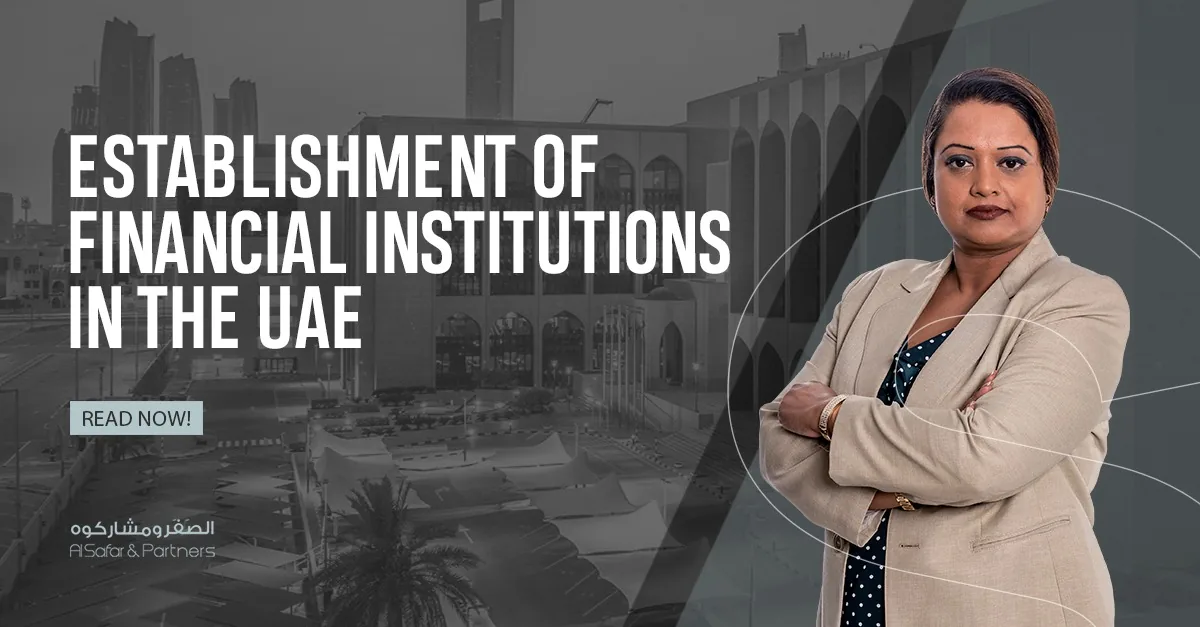
Written By: Mrs. Kavitha Panicker - Managing Partner at Al Safar and Partners Law Firm.