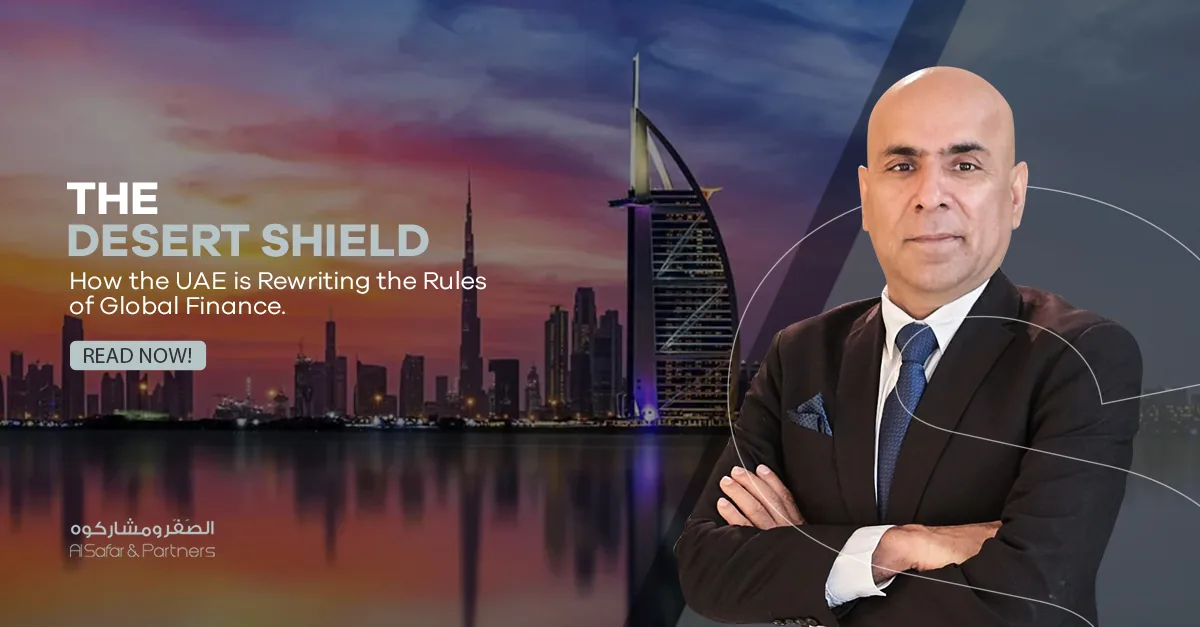
The United Arab Emirates is not just cleaning up its act; it is setting a new global benchmark for financial integrity.
IN THE high-octane world of global finance, where capital flows with the speed of a desert wind, the United Arab Emirates (UAE) has long occupied a singular position. As the vital conduit between Europe, Asia, and Africa, its gleaming skyscrapers and bustling ports are the engines of a modern Silk Road. Yet, for years, critics suggested that this openness came at a cost: a perceived vulnerability to the shadowy world of illicit finance. Today, those concerns are being addressed by a legislative and enforcement overhaul so comprehensive it has transformed the Emirates into a fortress of financial transparency.
The journey from the Financial Action Task Force (FATF) “grey list” in early 2024 to a position of global leadership has been remarkably swift. While many nations treat anti-money laundering (AML) reforms as a box-ticking exercise in technical compliance, the UAE has opted for a far more ambitious path. The centerpiece of this transformation is Federal Decree-Law No. 10 of 2025, which came into effect on October 14, 2025. This landmark legislation does not merely update the rules; it fundamentally redefines the relationship between the state, the private sector, and the proceeds of crime.
A New Era of Accountability
The 2025 decree introduces several groundbreaking elements that signal a “zero- tolerance” era. Perhaps most significant is the shift to an objective test for money laundering offenses. Under the new law, it is no longer enough for a financier to claim ignorance; if a “reasonable person” should have discerned the illicit nature of funds, the individual or entity can be held liable. This closes the “willful blindness” loophole that has long plagued global financial centers.
Furthermore, the law introduces personal criminal liability for managers whose actions or lack thereof contribute to an offense. When combined with the abolition of
all limitation periods for financial crimes under Article 37, the message is clear: there is no longer a clock to run out on illicit activity. Accountability in the UAE is now both personal and permanent.

The Teeth Behind the Text
Legislative brilliance is meaningless without the steel of enforcement, and here the UAE’s regulatory bodies have shown remarkable vigor. The Central Bank of the UAE (CBUAE) has emerged as a formidable guardian, issuing over AED 370 million in fines in 2025 alone. High-profile actions, such as the AED 200 million penalty imposed on an exchange house and the AED 18.1 million fine on two foreign bank branches in May 2025, underscore that even the largest players are not beyond the reach of the law.
The Ministry of Economy and Tourism (MOET) has been equally proactive, particularly in monitoring Designated Non-Financial Businesses and Professions (DNFBPs). In the first half of 2025, MOET uncovered more than 1,063 violations within these sectors,
which include real estate and precious metals, resulting in fines exceeding AED 42 million. This granular level of oversight is supported by the UAE Financial Intelligence Unit (UAEFIU), which delivered 288 technical reports in 2024 to support high-impact investigations and signed eight new international Memoranda of Understanding to strengthen global cooperation.
The use of advanced technological solutions like the goAML portal for suspicious transaction reporting and the Fawri Tick system for immediate tracking of financial crimes further exemplifies the UAE’s commitment to modern enforcement.
Beyond the Grey List
The UAE’s removal from the FATF grey list in February 2024 was an affirmation of its technical progress. Its subsequent removal from the European Union’s list of high-risk third countries in August 2025 was a further vote of confidence. However, the nation is not resting on its laurels. The upcoming FATF evaluation in June 2026 will shift the focus from “technical compliance” to “real-world outcomes,” a challenge the UAE is meeting with a robust, data-driven strategy.
The recent forum in Abu Dhabi on March 11, 2026, which brought together private- sector leaders and regulatory experts, exemplifies the UAE’s collaborative approach. By fostering a culture of “preventive compliance” and encouraging public-private dialogue, the Emirates is ensuring that its financial defenses are not just strong, but intelligent and adaptive.
In a global economy increasingly fragmented by geopolitical tensions and the complexities of digital finance, the UAE has chosen a clear path. By balancing the agility of a global hub with the rigor of a world-class regulatory regime, it has created a model of proactive enforcement. The desert shield is now firmly in place, protecting not just the wealth of the Emirates, but the integrity of the global financial system itself.
For more information and legal consultation reach out to Al Safar and Partners Law Firm at +971 52 758 3267 - reception@alsafarpartners.com or visit https://www.alsafarpartners.com.
Written by: Mr. Niaz Brohi - Partner and & Senior Legal Counsel at Al Safar and Partners Law Firm.