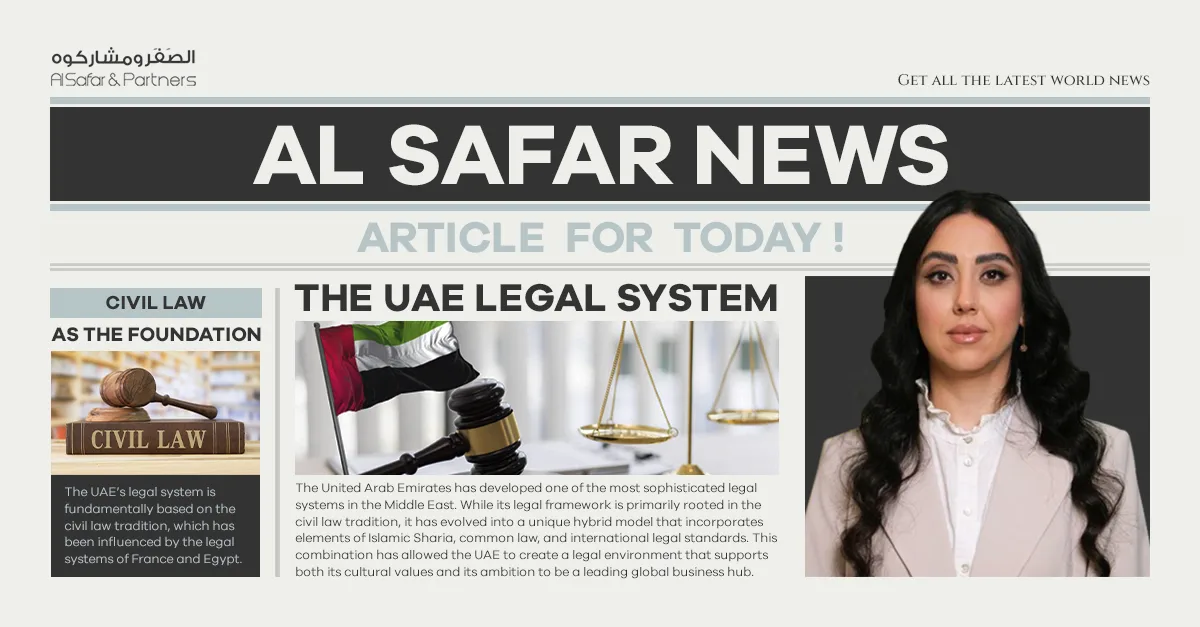
The United Arab Emirates has developed one of the most sophisticated legal systems in the Middle East. While its legal framework is primarily rooted in the civil law tradition, it has evolved into a unique hybrid model that incorporates elements of Islamic Sharia, common law, and international legal standards. This combination has allowed the UAE to create a legal environment that supports both its cultural values and its ambition to be a leading global business hub.
For businesses, investors, and individuals operating in the UAE, understanding the structure of its legal system is essential. It explains not only how laws are made and applied but also why certain disputes are handled differently depending on where they arise.
Civil Law as the Foundation
The UAE’s legal system is fundamentally based on the civil law tradition, which has been influenced by the legal systems of France and Egypt. Under this model, legislation enacted by the federal and local governments forms the primary source of law. Courts interpret and apply written legislation rather than relying on judicial precedent as a binding source of law.
The Federal Constitution establishes the framework of the country’s legal system and distributes legislative powers between the federal government and the individual emirates. Federal legislation governs most areas of commercial, civil, criminal, labour, and procedural law, while certain matters remain within the legislative authority of individual emirates.
This emphasis on codified legislation provides a high degree of certainty, allowing businesses and individuals to understand their legal rights and obligations by referring directly to the applicable laws.
The Role of Islamic Sharia
Although the UAE follows a civil law system, Islamic Sharia remains an important source of legislation. The Constitution recognises Sharia as a principal source of law, particularly in matters concerning personal status, including marriage, divorce, inheritance, and guardianship for Muslims.
In commercial and corporate matters, however, modern legislation generally governs legal relationships. This reflects the UAE’s approach of balancing respect for Islamic legal principles with the practical requirements of an international economy.
In recent years, the UAE has also introduced significant reforms in areas such as family law and personal status, providing greater flexibility for expatriates and allowing, in certain circumstances, the application of foreign law or specialised legislation.
The Influence of Common Law
One of the UAE’s most distinctive characteristics is the coexistence of civil law courts with common law jurisdictions established within certain financial free zones.
The Dubai International Financial Centre (DIFC) and the Abu Dhabi Global Market (ADGM) each operate independent legal systems based largely on English common law. These jurisdictions maintain their own courts, procedural rules, and legislation, which differ from those applied by the UAE’s onshore courts.
Unlike the civil law courts, judicial precedents play a far more significant role in the DIFC and ADGM courts, creating greater predictability in commercial dispute resolution for international businesses accustomed to common law systems.
This dual structure provides businesses with greater flexibility when choosing the legal framework that best suits their commercial arrangements.
Specialised Courts and Modernisation
The UAE has continuously modernised its judiciary by establishing specialised courts and adopting digital technologies to improve efficiency.
Commercial, labour, family, and administrative disputes are often heard by specialised judicial divisions with expertise in the relevant area of law. Many court procedures are now conducted electronically, allowing parties to file claims, submit documents, and attend hearings remotely in appropriate cases.
Alongside the court system, the UAE actively promotes alternative dispute resolution through arbitration and mediation. Arbitration, in particular, has become a preferred mechanism for resolving complex commercial disputes, supported by modern arbitration legislation that aligns with international standards.
A Business-Friendly Legislative Framework
Over the past decade, the UAE has introduced numerous legislative reforms aimed at strengthening its position as a global investment destination. Changes to company laws, foreign investment regulations, insolvency legislation, employment laws, and data protection frameworks have significantly enhanced the country’s legal infrastructure.
These reforms demonstrate the UAE’s willingness to adapt its legal system to meet international best practices while preserving its domestic legal principles.
For investors, this means operating within a legal environment that combines regulatory certainty with increasing flexibility to accommodate cross-border transactions and international business structures.
The Importance of Choosing the Right Jurisdiction
One aspect that distinguishes the UAE from many other countries is the availability of multiple legal jurisdictions within a single state.
Businesses establishing operations in the UAE should carefully consider whether to operate onshore, within a financial free zone, or within another specialised free zone, as each jurisdiction has its own regulatory framework, courts, and dispute resolution mechanisms.
Similarly, parties entering into commercial agreements should pay close attention to governing law and jurisdiction clauses. Choosing the appropriate legal framework at the outset can significantly affect how future disputes are resolved and the remedies available to the parties.
Obtaining legal advice before entering into significant transactions can therefore help avoid unnecessary legal uncertainty and reduce future risks.
Conclusion
The UAE legal system represents a successful blend of tradition and modernity. Its civil law foundations provide stability through comprehensive legislation, while the integration of Sharia principles reflects the country’s legal heritage. At the same time, the existence of common law jurisdictions such as the DIFC and ADGM, together with ongoing legislative reforms, demonstrates the UAE’s commitment to supporting international commerce and investment.
This hybrid legal structure has become one of the country’s greatest strengths. By combining different legal traditions within a coherent framework, the UAE has created a legal system capable of serving both domestic needs and the expectations of a global business community.
Written By: Dr. Sara Aghaei - Partner & Senior Legal Consultant at Al Safar and Partners Law Firm.